



Buying a home is a major milestone in the United States. For many individuals and families, it represents a key step toward long-term financial stability.
A mortgage is the primary financial instrument used to purchase that first residential property. Millions of Americans use this type of financing to achieve their dream.
Understanding today’s housing market requires careful planning. You need a clear grasp of how the financing process works.
As a first-time buyer, you must navigate various financial requirements. The goal is to secure a financing option that fits your specific budget and long-term goals.
This guide provides essential tips to help you manage the process successfully. Our goal is to prepare you for obtaining your first property in the United States.
Key Takeaways
- Buying a house is a major financial step that requires careful planning.
- A mortgage is the most common tool used to finance a home purchase.
- Understanding your budget and long-term goals is crucial from the start.
- The current market has specific requirements for first-time buyers.
- Getting your finances in order early makes the entire process smoother.
- Comparing different lenders and loan products is a smart move.
- Being prepared can help you secure the best possible terms for your situation.
Understanding Mortgage Loans: The Basics
Getting familiar with the key elements of your monthly housing cost will empower your buying journey. This knowledge helps you budget accurately and ask the right questions.
What Is a Mortgage?
A mortgage is a specific type of secured loan. The home you purchase acts as collateral for the lender. This means if you fail to make payments, the lender can claim the property.
The Components of Your Mortgage Payment (PITI)
Your monthly payment is more than just repaying borrowed money. It’s typically broken into four parts, known as PITI.
Principal is the actual amount you borrowed to buy the house. Interest is the cost charged by the lender for lending you that money.
Property taxes are often collected monthly by your lender. They hold these funds in an escrow account to pay your local government bill.
Homeowners insurance is also required. Lenders mandate this to protect the property’s value against damage or loss for the loan’s duration.
Navigating the Mortgage Process for Beginners
Understanding the timeline and major events in the property acquisition process will build your confidence as a buyer. The journey follows a clear sequence from your initial application to getting the keys.
Step-by-Step Overview
It all starts with a preapproval letter. This document shows sellers you are a serious contender who can secure financing. Once your offer is accepted, the real work begins for your chosen financial institution.
They start the underwriting process. Here, they verify your finances and the home’s value. A title company also checks public records to ensure the property has a clear history.

Key Milestones from Application to Closing
Just before the final meeting, you will do a final walk-through. This ensures any agreed-upon repairs are complete. Then, you reach the main event: the closing.
At this meeting, you sign a stack of paperwork. You will also provide your down payment and cover the final costs. After that, the home is officially yours.
Qualifying for Your Mortgage Loan
Your ability to secure financing hinges on meeting specific financial criteria. Lenders look at a complete picture of your finances before giving approval.
They need confidence you can manage the monthly payment long-term. This review focuses on two main areas: your credit health and your stable earnings.
Credit Score and Debt-to-Income Ratio
Your credit score is a vital number. A higher score generally helps you qualify for better terms and a lower interest rate.
Lenders also calculate your debt-to-income (DTI) ratio. They compare your total monthly debt to your gross monthly income.
Most set a maximum DTI between 41% and 45%. Staying below this threshold shows you can afford the new housing cost.

Documenting Your Income and Employment
Proof of stable income is non-negotiable. Most lenders require a steady employment history for the last two years.
You must provide documents like recent pay stubs, W-2 forms, and federal tax returns. This paperwork verifies your earnings during the application process.
Consistent income reassures the lender about your repayment ability. Gather these records early to avoid delays.
| Qualification Factor | Lender Requirement | Impact on Approval |
|---|---|---|
| Credit Score | Good to Excellent (670+) | Higher scores secure lower rates and better terms. |
| Debt-to-Income Ratio | Typically below 45% | A lower ratio increases your borrowing power and approval odds. |
| Employment History | Last 2 years steady | Shows reliable income to cover future payments. |
| Income Documentation | Pay stubs, W-2s, tax returns | Provides concrete proof of your stated earnings. |
Choosing the Right Mortgage Type for Your Needs
With several financing paths available, picking the right one requires careful comparison. Your selection shapes your monthly budget and long-term stability.
It’s a foundational decision for your property purchase.
Fixed-Rate vs. Adjustable-Rate Options
A fixed-rate product offers predictable payments for the entire term. Your interest rate never changes.
An adjustable-rate mortgage (ARM) often starts with a lower rate. A popular choice is the 5/1 ARM. Its rate is fixed for five years before it can adjust annually.
Exploring Government-Backed Programs
Conventional loans follow guidelines from Fannie Mae and Freddie Mac. Some allow down payments as low as 3%.
Loans backed by the Federal Housing Administration (FHA) help buyers with lower credit scores. The FHA loan limit for a one-unit home is often $472,030.
USDA loans are guaranteed by the U.S. Department of Agriculture. They allow for no down payment in designated rural areas.
Jumbo financing is for amounts exceeding conforming limits, like $726,200.
| Program Type | Key Feature | Best For |
|---|---|---|
| Conventional Loan | Down payments as low as 3% | Buyers with strong credit seeking flexible terms |
| FHA Loan | Lower credit score requirements | First-time buyers or those with smaller savings |
| USDA Loan | No down payment required | Buyers in eligible rural and suburban areas |
| Jumbo Loan | Finances high-value properties | Purchases above conforming loan limits |
Deciding on Your Down Payment and Closing Costs
Your upfront cash investment is a critical factor in your home purchase journey. These initial expenses shape your immediate budget and affect your long-term financial picture.
Careful planning for both your down payment and closing costs is essential.
Budgeting for a Down Payment
A larger down payment reduces your borrowed amount. Putting down 20% often lets you avoid private mortgage insurance on a conventional purchase.
Saving for this lump sum requires discipline. Many programs allow lower contributions, but a 20% goal is common.
You must document the source of these funds. Lenders will request bank statements to verify the money is yours.

Understanding Closing Costs and Associated Fees
Closing costs cover various services needed to finalize your purchase. They typically range from 2% to 5% of your total loan amount.
These fees include items like appraisal and title search charges. Origination fees compensate the lender and usually are 0.5% to 1%.
Budget for these costs because they are paid in cash at your final appointment. Planning ahead prevents last-minute stress.
| Expense | Typical Range | Primary Function | Important Note |
|---|---|---|---|
| Down Payment | 3% – 20% of purchase price | Lowers principal and may eliminate PMI | Source of funds must be documented |
| Closing Costs | 2% – 5% of loan amount | Covers lender and third-party service fees | Paid in cash at final settlement |
| Origination Fee | 0.5% – 1% of loan amount | Compensates lender for processing | Often included in closing costs |
Tips to Improve Your Credit and Borrowing Power
Taking control of your credit can unlock better opportunities when buying property. Your financial profile is a key factor lenders evaluate.
It determines your borrowing power and the interest rate you receive. A stronger profile means more favorable terms.
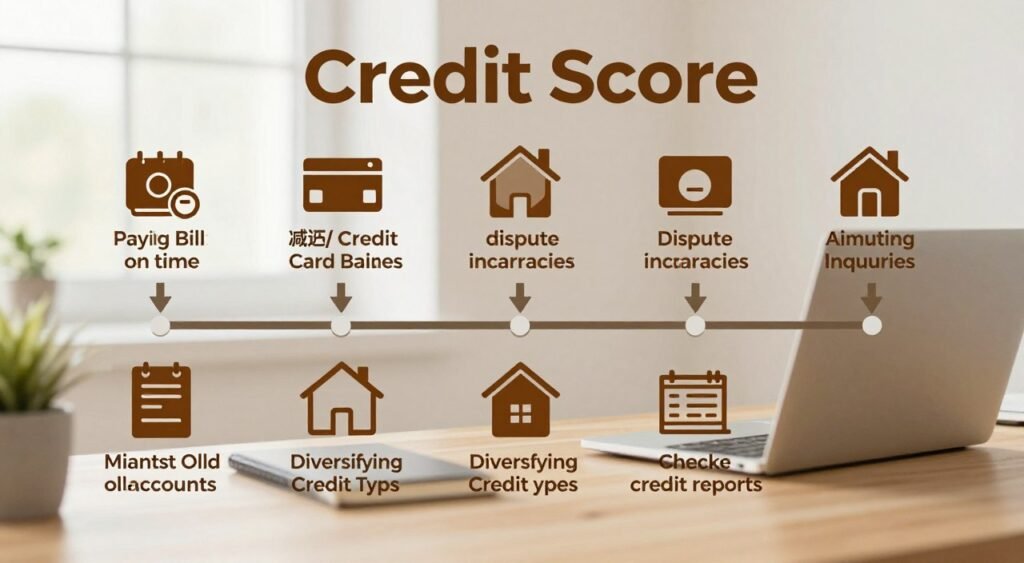
Focusing on a few key areas can make a significant difference. These actions help you present a more reliable picture to financial institutions.
Steps to Raise Your Credit Score
Paying every bill on time is the most powerful habit. Your payment history is the largest component of your credit score.
Consistency here shows you manage obligations responsibly. Set up automatic payments to avoid missed due dates.
Keep your credit card balances low compared to your limits. This is your credit utilization ratio.
Aim to use less than 30% of your available credit. High balances can signal risk, even if you pay them off monthly.
You are entitled to a free credit report annually from each major bureau. Review it for any errors or outdated information.
Disputing inaccuracies can quickly improve your score. Lenders rely on this report to assess your credit history.
Reducing other debts, like auto or student obligations, increases your qualification amount. It lowers your overall debt-to-income ratio.
This directly expands the monthly payment you can afford for a new home. A cleaner financial slate gives you more options.
Estimating Your Monthly Payment Using Calculators
Before you commit to a home purchase, estimating your future monthly payment is a crucial budgeting step. It turns a large purchase price into a manageable figure you can plan for each month.
Online tools make this easy. As of February 2026, the national median payment was $2,061.

How to Use a Mortgage Payment Calculator
Start by entering the home price. Then, input your planned down payment amount and your expected interest rate.
The calculator shows your principal and interest payment instantly. You can also add estimated property taxes and insurance for a full picture.
Try different scenarios. See how a larger down payment lowers your monthly cost.
Compare a 30-year term to a 15-year term. The shorter term has a higher payment but saves you thousands in interest over time.
| Scenario | Home Price | Down Payment | Loan Term | Est. Monthly Payment (P&I)* |
|---|---|---|---|---|
| Low Down Payment | $400,000 | 3% ($12,000) | 30-year fixed | $1,850 |
| Moderate Down Payment | $400,000 | 10% ($40,000) | 30-year fixed | $1,650 |
| 20% Down Payment | $400,000 | 20% ($80,000) | 15-year fixed | $2,400 |
*Payment for Principal & Interest only. Taxes and insurance are extra.
Finding the Best Lenders and Mortgage Rates
To maximize your long-term savings, you need to actively shop for the most advantageous financing terms. This search is a powerful step in your home buying journey.

Recent data shows the average for a 30-year fixed purchase is 6.28%. This figure is a helpful starting point for your comparisons.
Comparing Rates by State and Program
Always get quotes from at least three different providers. This allows you to see the full range of available offers.
Remember, interest rates can change daily. Gather your quotes on the same day for an accurate side-by-side view.
Ask your real estate agent or local contacts for lender recommendations. A trusted referral can lead you to a reliable partner.
Consider requesting a rate lock from your chosen institution. This protects you from increases before your closing date.
Preparing for the Mortgage Application Process
Organizing your financial documents is the key to a smooth and fast approval journey. Proper preparation prevents frustrating delays and helps you move quickly once you find your home.
Many financial institutions advertise 24- to 48-hour underwriting times. Complex situations, however, often need extra time for document review.
Gathering Essential Documents
You must keep your W-2s, pay stubs, and federal tax returns organized. Recent bank statements are also required to verify your assets.
Having these papers ready from the start speeds everything up. Providing prompt responses to requests for more paperwork prevents holdups.
What Lenders Look for in Your Application
Underwriters verify your income and employment history. They need proof you have the stability for a regular monthly payment.
This assessment reviews your credit, income, and total debt. The goal is to confirm you meet all requirements for final approval.
A complete financial picture gives them confidence in your application. It shows you can manage the new housing cost long-term.
Exploring Mortgage Refinancing and Home Equity Options
Your home isn’t just a place to live; it can also become a source of financial flexibility as you build ownership. Over time, you may explore options to adjust your existing mortgage or tap into your property’s value.
When Refinancing Might Be Right for You
Many homeowners consider a refinance when market interest rates drop. Recent data shows average refinance rates around 6.81%.
Securing a lower interest rate can significantly reduce your monthly payment. This frees up cash for other goals.
A cash-out refinance lets you convert built-up equity into cash. Use it for major home improvements or to pay off high-interest debt.
Switching from a 30-year to a 15-year loan term is another smart move. Your payment rises, but you save thousands in interest over time.
Alternatively, a home equity line of credit (HELOC) works like a credit card. You borrow against your equity as needed, often with flexible repayment terms.
Conclusion
Successfully navigating the path to purchasing your first property culminates in a rewarding sense of accomplishment. Your careful preparation of credit, income, and savings forms a solid foundation for securing a mortgage.
Understanding all parts of your monthly payment, like taxes and insurance, helps you manage your budget for the long term. Comparing offers from several lenders is the best way to secure favorable loan terms.
Remember the key steps from preapproval to closing. With thorough research and expert guidance, you can move forward with confidence in the U.S. housing market.
FAQ
What exactly is a mortgage?
What makes up my total monthly housing payment?
How does the process of getting a home loan work?
What do lenders check to approve my application?
What are the main types of home financing available?
How much money do I need upfront to buy property?
How can I make my credit profile stronger?
How do I estimate what I’ll pay each month?
How do I find the best deal from a bank or credit union?
What paperwork is essential when I apply?
Post a comment
Related Posts

Find Affordable Insurance Quotes in the United States
Protecting your vehicle and your wallet is a top priority for every driver. Finding the…

Find Cheap Car Insurance Quotes Fast in the United States
Getting the right coverage for your vehicle doesn’t have to be a long, confusing process.…

Find the Best Auto Insurance Quote in the United States
Navigating the world of vehicle protection in the U.S. can feel overwhelming. With so many…

Compare Home Insurance Quotes for the Best Rates Today
Securing the right protection for your property begins with a simple, powerful step: comparison. To…